can a tiny plant help feed a space mission?
the research
Turns out we actually tested this. Not a thought experiment, an actual 21-day study with treatment groups, controlled variables, and a poster board to prove it.
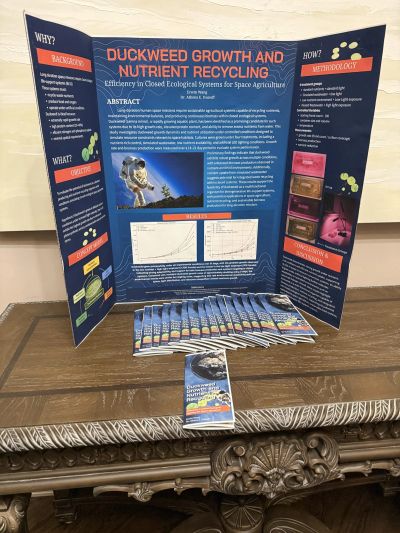
Duckweed Growth and Nutrient Recycling: Efficiency in Closed Ecological Systems for Space Agriculture
Erwin Wang, with Dr. Athena E. Ivanoff
THE QUESTION
Can duckweed efficiently convert nutrient-rich water into usable biomass, under conditions that mimic a closed ecological system in a space habitat?
WHY DUCKWEED, SPECIFICALLY
Turns out duckweed is kind of overqualified for this job. It's fast-growing, compact and water-based (no soil, no wasted space), 20-40% protein by weight, great at pulling excess nutrients out of water, and fine with artificial, indoor, controlled conditions. Basically everything a bioregenerative life-support system would want in a crop.
THE HYPOTHESIS
Duckweed grown in diluted-nutrient conditions, under increased light intensity, would show the highest growth rate, the idea being that more light drives more photosynthesis, and lower nutrient stress means less energy spent competing for resources.
HOW IT WAS TESTED
100 fronds to start, then split across 4 treatment groups over 21 days: a nutrient-rich control (standard nutrients, standard light, the baseline), simulated wastewater (nutrient-enriched water, testing whether duckweed can recycle nutrients out of it), a low-nutrient environment (nutrients diluted to simulate resource limitations), and artificial LED lighting (controlled light modeling space-habitat conditions). Tracked throughout: growth rate (frond count and surface coverage), biomass production, and nutrient uptake.
WHAT ACTUALLY HAPPENED
Duckweed grew in every single condition, that's the headline. But the amount varied a lot. Best performer: the low-nutrient + high-light group, going from 100 fronds to about 1,700 fronds in 21 days. Slowest performer: the low-light group, landing around 700 fronds. For reference, duckweed under ideal conditions roughly doubles every 3 days. The experimental groups trended similarly but ran a bit behind that pace, likely due to real-world constraints like limited space, uneven light distribution, and the plants literally competing with each other for room to grow.
SO WHAT DOES THIS MEAN
Duckweed backed up its reputation: strong growth under nutrient-rich conditions, efficient nutrient uptake from simulated wastewater, and it didn't seem to mind being stuck under an LED light indoors instead of the sun. That combination, grows fast, cleans water, tolerates artificial environments, is exactly what a closed-loop life-support system needs.
Potential applications: space agriculture, closed ecological systems, waste-to-resource conversion, sustainable biomass production, long-duration mission planning.
What's next: measuring nutrient removal more precisely, testing different light spectra, running longer growth periods, studying what's actually in the harvested biomass, scaling the system model toward something habitat-sized.
WHY THIS MATTERS FOR SPACE MISSIONS
Long-duration missions need every system on board to multitask. A crop that also recycles nutrients and helps balance a sealed environment is worth a lot more than a crop that just grows. That's the case for duckweed in future lunar and Martian bioregenerative life-support systems.
Questions about the project? Reach out at wangerwin6@gmail.com.
From the Lab

The research poster, presented alongside the actual duckweed trials it summarizes.

Container 1.1, the control group: normal nutrients, normal light.
Container 4.4: low nutrients, high light. This was the fastest-growing group in the trial.
Container 2.2: diluted nutrients (1/10 strength), normal light — testing how duckweed handles a resource-limited environment.
Container 3.3: normal nutrients, low light. This was the slowest-growing group, showing how much light matters for growth rate.
Duckweed fronds under the grow lamp, close up. Each tiny leaf here is one data point in the frond count.